Junior developer employment ages 22-25 dropped 20% from the 2022 peak. Entry-level hiring is down 25% year-over-year. AWS CEO Matt Garman called cutting juniors "one of the dumbest things" because it hollows the talent pipeline. He is correct. The industry is optimizing for quarterly productivity while destroying multi-year talent formation.
The structural problem: AI now does the tedious work that trained juniors to become seniors. Boilerplate, scaffolding, repetitive CRUD—the cognitive reps that built intuition. Startups skip juniors entirely. Big tech hires only candidates with prior internships at big tech. The pipeline is collapsing.
The Decomposition Breakthrough
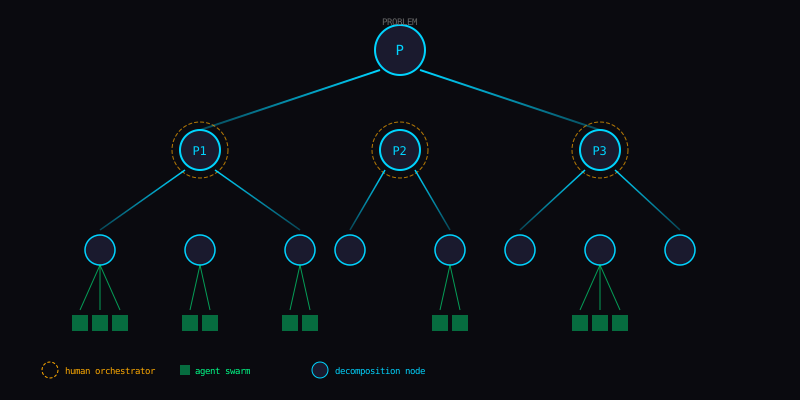
Cursor just demonstrated something that changes the calculus. Hundreds of agents coordinating on a single codebase for weeks. Three million lines of code. Planners explore the codebase and create tasks. Workers execute without coordination overhead. The architecture: recursive decomposition.
This is not new computer science. NASA's FAME mission launching in 2026 is the largest in-space multi-agent AI demonstration, using decomposition algorithms. Google's Agent Development Kit implements parent agents that assign subproblems to specialized subagents via LLM-driven delegation. UCL research shows agents dynamically generating and coordinating additional agents for complex analytical requests.
The pattern is universal: break the problem into subproblems, assign subproblems to specialized executors, aggregate results, verify coherence. Recursively. The agents handle execution. Humans handle decomposition decisions and verification.
The Skills Inversion
The old training model: juniors write code, debug mistakes, learn fundamentals, become seniors. The tedious work was the training. Remove the tedious work, remove the training.
The new training model inverts this. Juniors decompose problems, orchestrate agents, validate outputs, architect integrations. They become senior orchestrators. The fundamentals remain—computational thinking, system design, debugging—but the medium changed. Instead of learning by writing boilerplate, they learn by observing decomposition patterns and verifying agent outputs.
This is not a downgrade. Compositional systems thinking is harder than writing CRUD endpoints. Translating business intent into verifiable agentic workflows requires deeper understanding than copying Stack Overflow. The juniors who master human+AI teaming become indispensable because they bridge the gap AI cannot: intent specification and output verification.
The Training Architecture
AgentiAgency trains consulting teams with 2-3 juniors and 2-3 seniors. This ratio is deliberate. The seniors architect decomposition strategies. The juniors execute agent orchestration, observe patterns, validate outputs, and learn to architect by watching architecture happen.
The tooling evolves daily. Agentic frameworks ship breaking changes weekly. New capabilities emerge faster than any individual can track. Our infrastructure automatically vets daily tooling innovations and pushes validated updates to each engineer. Juniors interact with cutting-edge agentic workflows continuously because the alternative—manual tool evaluation—cannot scale at this velocity.
Hyper-specialized agent swarms mean juniors learn problem breakdown, agent coordination, and verification in production contexts. Every agent action is auditable—natural teaching moments for security and compliance thinking. The recursive decomposition tree is literally a training scaffold.

The Enterprise Reality
Eighty percent of enterprise applications will embed AI agents by end of 2026. Bounded autonomy requires human oversight, escalation paths, checkpoints. Someone must design those boundaries. Someone must validate agent outputs. Someone must maintain provenance trails.
Senior engineers are bottlenecks. There are not enough of them, and training more takes years. Junior engineers trained in agentic decomposition become force multipliers immediately. They handle the orchestration and verification work that would otherwise queue behind senior capacity constraints.
The companies investing in agentic training infrastructure today build competitive moats for 2028. The talent they develop cannot be hired away because it does not exist elsewhere. The companies who cut juniors for short-term margin improvement will face mid-level engineer shortages they cannot hire their way out of.
The Inevitable Transition
Everyone who does not start using AI to increase their agency is at risk. Every job involving human and regulatory friction is at risk. Every job that exists primarily to gatekeep or align is at risk. This is not threat—it is observation. The roles that survive are the roles that compound human judgment with agent execution.
In every meeting, 2-3 people share this vision and are eager to succeed. They see the decomposition dividend clearly. They understand that recursive agent swarms are not replacement but amplification. They want to build the training infrastructure that produces the engineers of 2028.
If you are one of those people: send me an email. We will make you successful. The train is leaving. Get on now.